
EssenceMind
The Architecture of Consciousness
EssenceMind™ is an Architectural Framework for understanding consciousness. It describes consciousness as organized through four interrelated dimensions: Awareness, Identity, Perception, and Coherence.
EssenceMind
An Architectural Framework for Understanding Consciousness
EssenceMind™ offers a clear, grounded way of understanding human experience.It does not teach techniques, prescribe practices, or promise transformation. Instead, it reveals the underlying architecture through which experience already arises—quietly shaping how we think, feel, relate, and make sense of the world.


What EssenceMind Is
EssenceMind is a framework for understanding consciousness as an organized system rather than a collection of symptoms, traits, or states.It approaches experience architecturally—asking not what you feel or think, but how experience is structured from the inside.From this view, confusion, strain, clarity, and ease are not personal failures or achievements. They reflect how awareness, identity, perception, and coherence are interacting in a given moment.EssenceMind does not attempt to improve or optimize the system. It helps make the system intelligible.
Why Architecture (Not Techniques)
Most approaches to personal growth focus on strategies: practices to apply, habits to build, states to reach, or skills to master.EssenceMind takes a different stance.It suggests that when the underlying architecture of experience is strained or incoherent, techniques often add pressure rather than relief. Effort may temporarily change content—thoughts, emotions, behaviors—without addressing the structure that generates them.Architectural understanding works in the opposite direction.Instead of intervening, it clarifies. Instead of directing change, it reveals conditions. From that clarity, change may occur—or it may not. Either outcome can be coherent.

The Four Dimensions of Experience
EssenceMind describes consciousness as organized through four interrelated dimensions:
Awareness – the field of contact with experience, including its width, clarity, and effort
Identity – the organizing center of selfhood that stabilizes experience and protects coherence
Perception – the meaning-making function through which reality is interpreted
Coherence – the degree of alignment among the dimensions at any given time
These dimensions are always present. They vary naturally across situations, relationships, and environments. None of them is meant to be expanded, softened, or corrected.What matters is how they function together.
Coherence As A Condition
Within the EssenceMind framework, coherence is not an achievement. It is a condition.When coherence is present, experience feels intelligible, even when it is difficult. When coherence is absent, effort increases and clarity diminishes, regardless of intention or skill.Many attempts at change fail not because of resistance, fear, or lack of discipline, but because coherence is missing. Without coherence, pushing for resolution often intensifies strain.EssenceMind reframes change as something that follows clarity, not something that produces it.

What EssenceMind Is Not
To avoid misunderstanding, it is important to be explicit.EssenceMind is not:
a therapeutic modality
a coaching method
a spiritual path or belief system
a performance or productivity framework
a set of practices or exercises
a promise of awakening, healing, or transformation
It does not tell you what to do, who to become, or how to fix yourself.
The Book
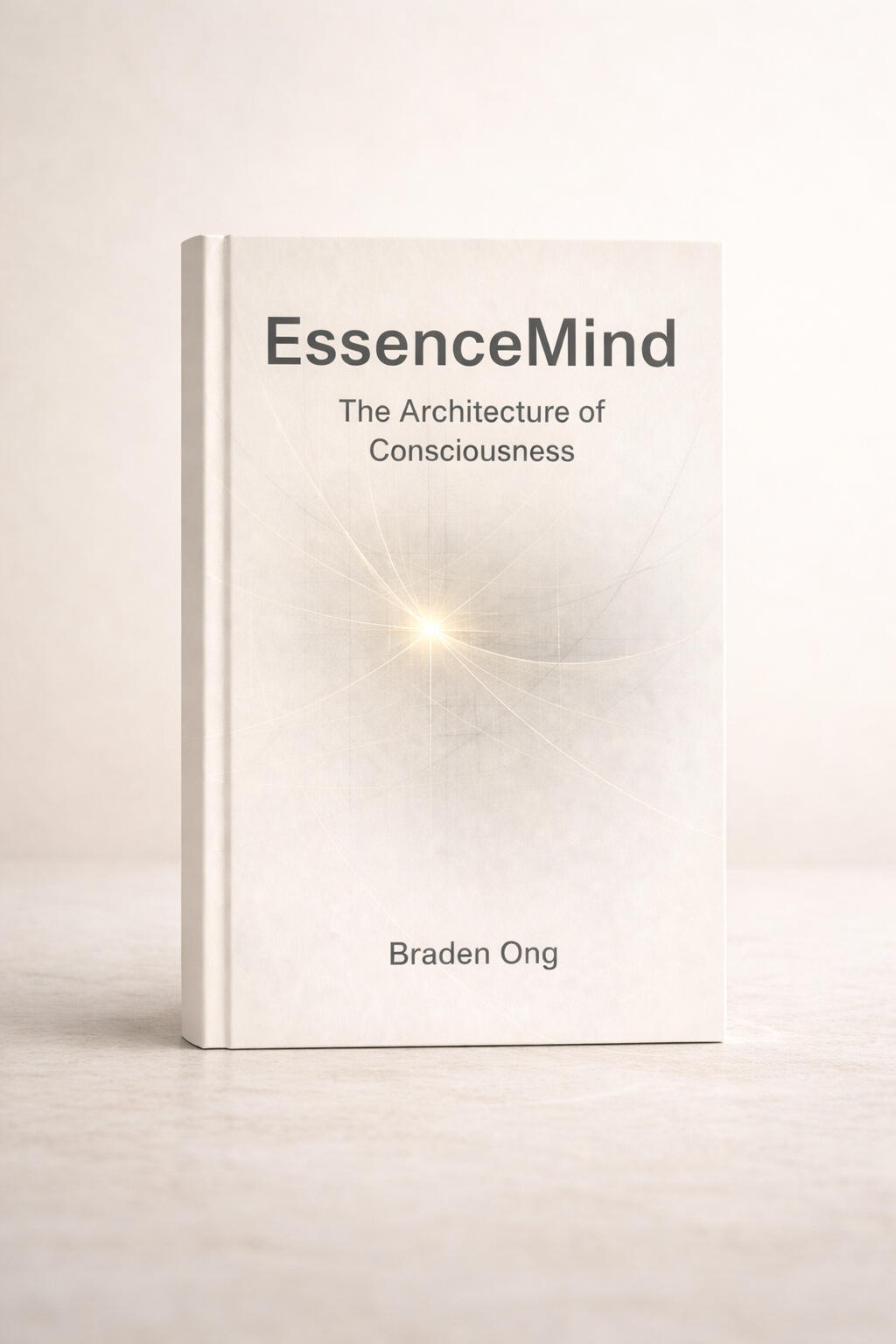
EssenceMind: The Architecture of Consciousness
The book is the primary expression of the EssenceMind framework.It presents the full architectural model in depth, exploring how awareness, identity, perception, and coherence shape lived experience across inner life, relationships, and environments.The book is written for readers who want clarity without ideology and depth without instruction manuals. It avoids techniques, prescriptions, and outcome promises, focusing instead on recognition and understanding.If you want to engage EssenceMind seriously, the book is the place to begin.View the Book
EssenceMind: The Architecture of Consciousness can be purchased here.
About The Work
EssenceMind emerged through sustained observation across contemplative inquiry, relational experience, and technology-assisted reflection.The framework was developed slowly and with restraint, prioritizing clarity over completeness and integrity over expansion.This work does not depend on belief, affiliation, or authority. It stands or falls on whether it helps experience make sense.Ongoing essays and reflections exploring adjacent questions are published separately on Substack.

Courses
EssenceMind courses are interpretive and orienting. They exist to support understanding of the framework, not to apply it.They do not teach practices, provide exercises, or aim to produce results. Participation is optional, and no course is required to understand EssenceMind.
EssenceMind Foundation
An introductory video course that presents the architectural model in a clear, structured format.The course explores:The four dimensions and their interactionNatural variation in consciousness architectureWhy effort does not create coherenceHow to observe experience without attempting to change itAdditional interpretive courses explore specific aspects of the framework, each with the same non-prescriptive stance.[View Courses]